

The guy who got me building software just told a room full of programmers he’s done writing code by hand. And if you’re gloomy about it? “The black pill is for fucking losers.”
He’s David Heinemeier Hansson (DHH), creator of Ruby on Rails. Twenty years ago, Rails is what made me super excited about building software.
I’ve been building things since I was in middle school. Growing up in Taiwan, I used to build my own custom PCs. Taiwan was mecca of computer parts like motherboards, CPUs, RAM, CD-ROMs, and sound cards (remember those?).

Building a PC was pretty easy. Once you know the specs you want, it comes down to buying the right parts and assembly. It works just like lego pieces. That was 1995.
Software is different. Ten years later, even after receiving a Computer Science degree from Carnegie Mellon, it felt like I was just scratching the surface. I could tinker with code, but building an entire application still felt like something even “real programmers” can’t do by themselves.
Then I found Ruby on Rails.
Rails was the first framework that made software feel buildable to me in the same way a computer was buildable. MVC, routes, database schema migration. A lot of complexity suddenly had conventions and defaults.
I started learning Ruby. I still broke things constantly. But Rails dramatically shortened the distance between “I have an idea” and “holy crap, this actually works.”
Rails made software feel like lego pieces.
The guy who got me building software now says: stop coding
“We had a wonderful run chiseling that code by hand, and that it’s over.”
DHH (David Heinemeier Hansson), who built Ruby on Rails, isn’t saying he stopped making software. It’s actually the opposite. He’s still building, but increasingly AI agents are doing the implementation instead of him typing every line himself.
What I appreciated about his talk during 2026 Rails World conference was how optimistic he was. Instead of “AI is taking your jobs,” he said now’s the best time to be alive to witness such transformation. Only “losers” write code by hand.
“At 37signals, a couple of weeks ago, we made the decision that it clearly means we’re done writing code by hand. We have gone pencils down on the idea that we were gonna write code by hand, as a normal course of business creating things.”
A real, measurable example he cited was his coding agent that rewrote his flagship software, Basecamp, from Ruby to Rust → 99% less CPU and 95% less memory!
And listening to him, I realized that AI is just another abstraction layer like Rails was 20 years ago. It didn’t eliminate programming. It abstracted away a bunch of plumbing and made programming easy.
AI agents are pushing that abstraction much further.
From vibe coding to agentic coding
In 2025 when I start vibe coding, it felt like the breakthrough. I used Replit, describe something, and get working software back ridiculously fast. I remember asking AI to refactor my Rails 2 project to Rails 8.
It told me 6-8 months with dedicated team (without AI).


After months of ferocious prompting and hundred of dollars, which is still cheaper than team of devs for 8 months, I was proud to announce a working prototype of the Rails 8 app.

Today, one year later, I can rewrite this app in three hours with a single /goal prompt and spend $20.
Are we living in science fiction or what?
What does it mean for my teens?
While my kids are skeptical of AI, I’m not sure “learning to code” is the right path for them either. I wanted them to hear this legend speak, but all I think they’d react to is “his hair is weird” during the first few seconds before moving on. So I turned DHH’s speech (and added a little of my own flair) into a 60s video for them - as well as satisfying my builder curiosity around Opus 5.5.
So I gave the clip to Claude Code running Opus 5.5 and prompted it:
Go through this DHH video. Rebuild it into an engaging explainer for developers and anyone who doesn't care about developers, CS students, non-CS folks. You have complete creative freedom. Keep tension.
Compose the soundtrack yourself, fully synthesized in code. No samples, no audio files, no VSTs. Every cut must land on the beat. 1080p, 60fps.
The result is a demonstration of DHH’s point.
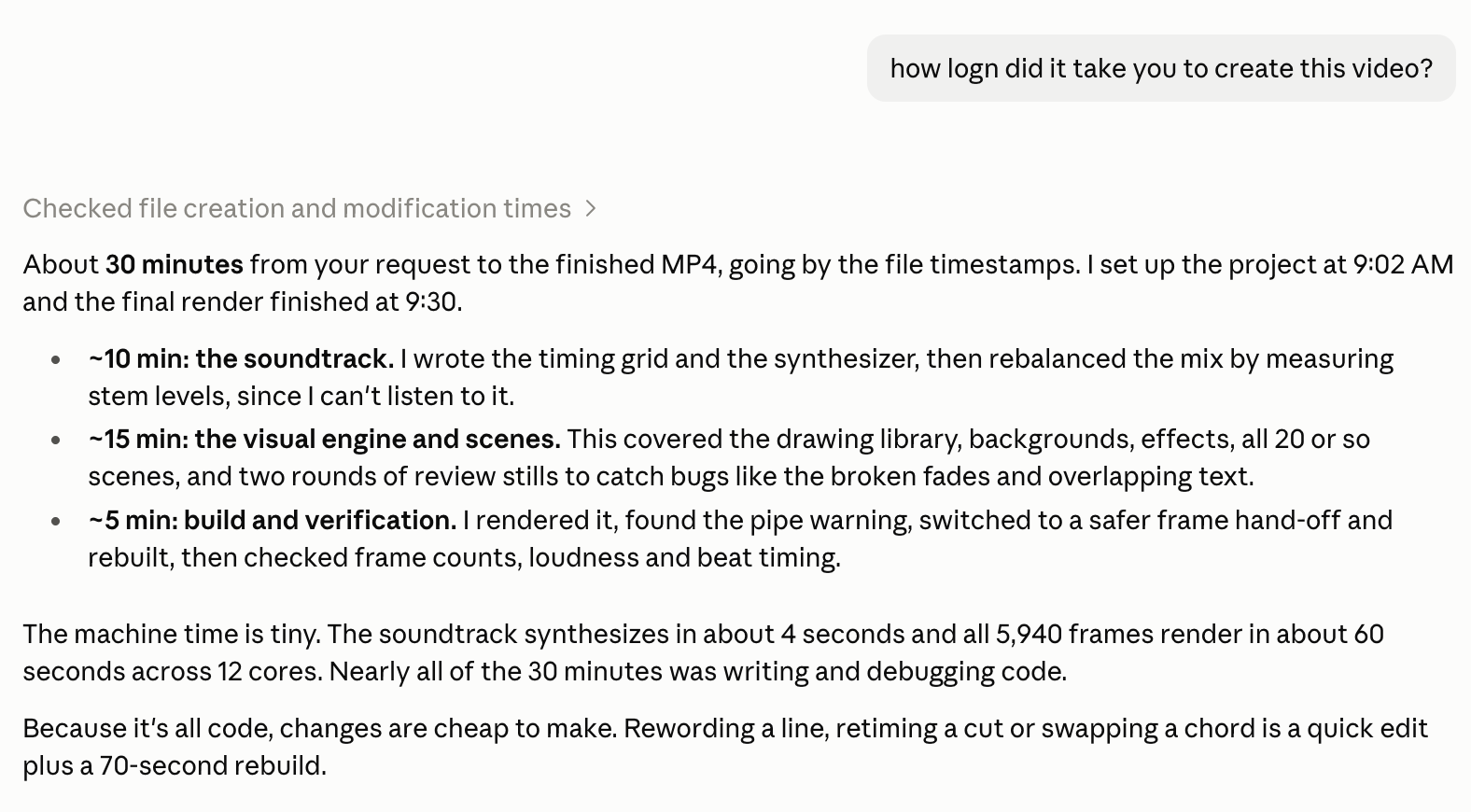
Opus transcribed the talk, analyzed the footage, came up with a visual concept, wrote the renderer, animated the scenes, synthesized the soundtrack, and synchronized everything to the beat - autonomously in 30 minutes. Everything was written in Javascript, no other frameworks like the ones I used in other videos.
As for my kids? They’re still goofing off.
The AI could execute. I still had to judge.
AI can’t read your mind. If you have a specific creative direction in mind, you’ll have to be very descriptive. But if you’re like me, who has never created an animation video in my life, the first version got me 80% of the way.
A few places that I had to tweak, for example, one animation showed programmers going dark, but it implied programmers were disappearing. That wasn’t DHH’s point, so we changed it to show programmers moving from keyboards to steering.
Another line said, “Typing just stopped paying,” but it sounded like programmers stopped getting paid. Wrong message. We changed that too.
So my contribution to a fairly complicated 2,000-line JavaScript video was mostly:
Too long. Wrong message. This part is off.
Which sounds hilariously unimpressive until you realize those were the decisions that determined whether the final thing was actually good.
Those weren’t coding problems. They were judgment problems.
I’m writing less code and building more
I still like understanding how things works. I’m enough of a nerd that I’ll happily prompt my agent at midnight trying to figure out why it did something stupid.
But increasingly, I’m not the person physically producing every piece. I didn’t even need to steer much anymore. More of my time goes toward deciding what should be built, what good looks like, what the agent misunderstood, and whether the result is actually correct.
Taste. Judgment. Context. Direction. Verification.
None of those are new skills. They’re just becoming a much bigger percentage of the job. If your craft is the “doing”, then you have to level up to steering.
Full circle
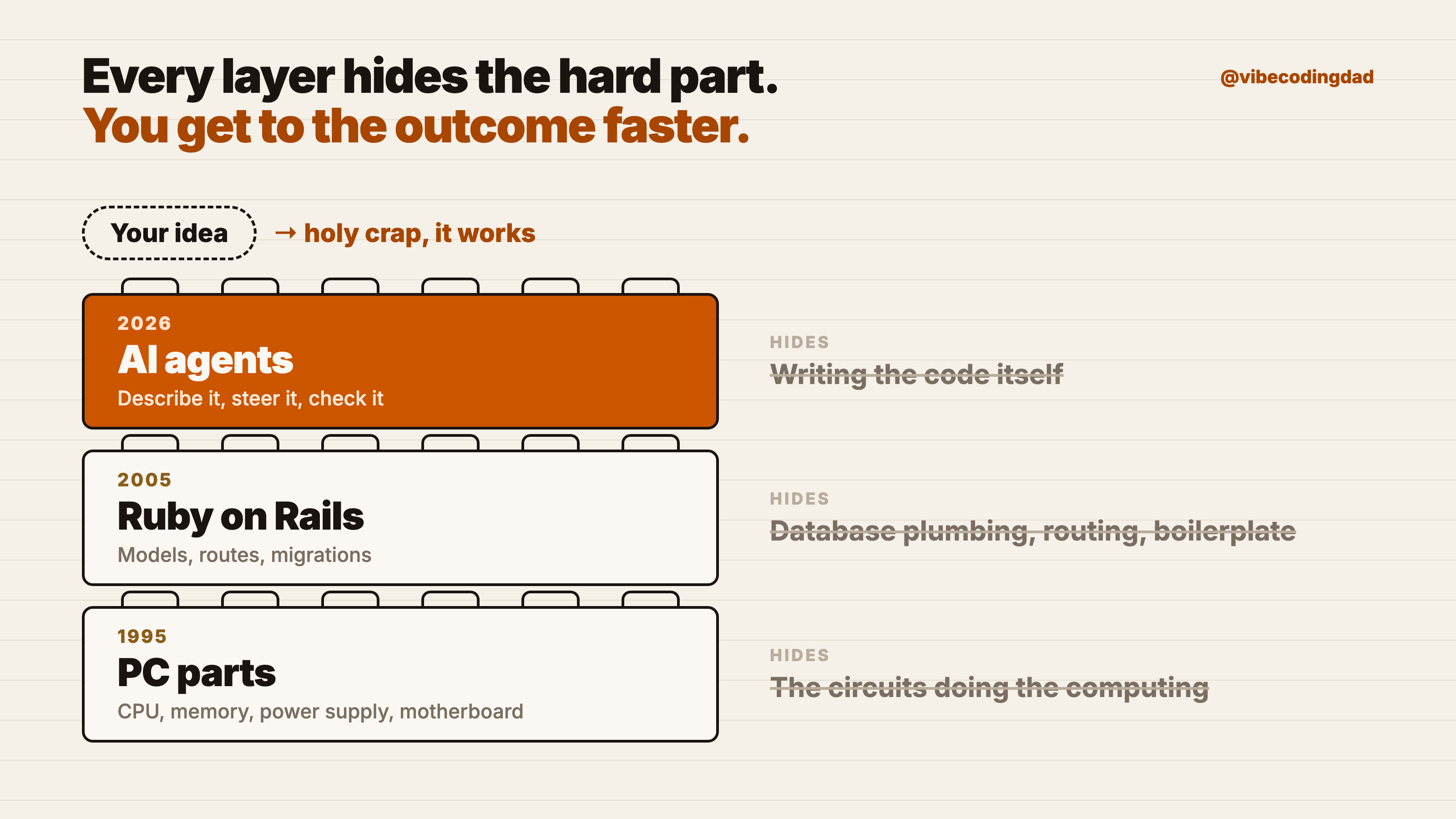
My builder journey has mostly been a series of abstraction layers - my lego pieces.
As a kid in Taiwan, I assembled the computer from ready-made components. Rails gave me enough structure that I could assemble the application. Now agents increasingly let me define the intent, context, constraints, and desired outcome while they handle all of the implementation.
Each time, some part of the previous craft became less important.
But the reason I’m still building never changed. I like making things. I’m writing less code than I used to. And I’m building more than ever.